
Governance · Global Wellbeing Index
Global Wellbeing Index: The True Measure of Governance Impact on Citizens
By Admin · Sep 14, 2026
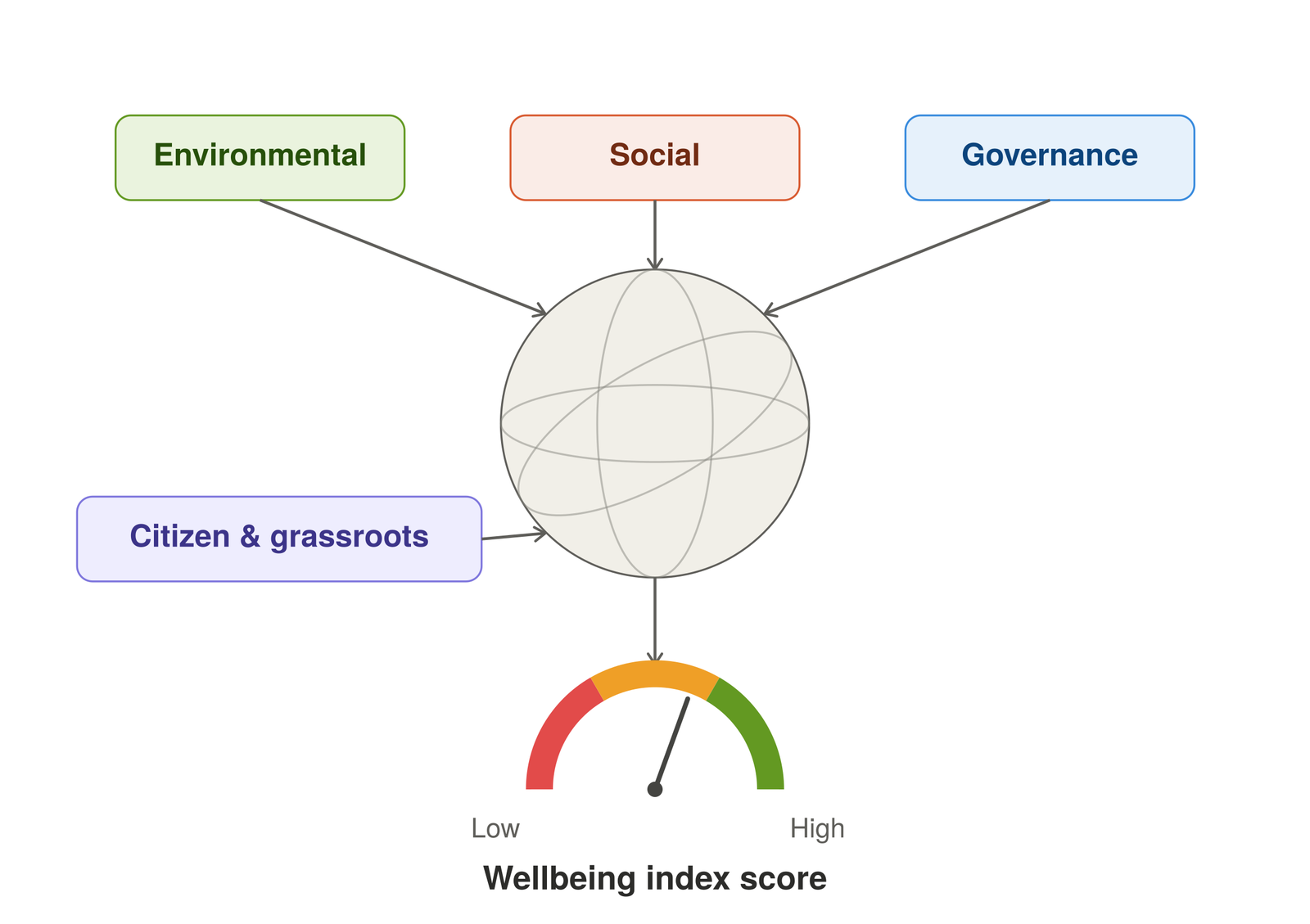
Global Wellbeing Index (GWI) is a new composite index being launched by the Global Wellbeing Forum to measure how much governance — through environmental, social, and governance (ESG) performance — actually improves citizens' lives, rather than just measuring policy compliance or institutional disclosure the way most existing ESG ratings do.
Why We Are Building This
Every year, dozens of indices rank nations on wealth, competitiveness, and corporate ESG compliance. Almost none of them ask the one question that matters most to a citizen: does governance actually make my life better?
Environmental, Social, and Governance (ESG) frameworks were built largely for investors and corporations — to price risk, guide capital, and satisfy disclosure regulators. They tell us whether a government or company reports well. They rarely tell us whether a nation's policies translate into longer, healthier, freer, or more secure lives for the people living under them.
The Global Wellbeing Index (GWI) is the Global Wellbeing Forum's response to that gap. It is designed to measure the lived impact of environmental, social, and governance performance on citizens — not just the presence of good policy on paper, but its outcome in people's daily lives.
What Makes This Index Different
Most composite indices — the Human Development Index, national ESG ratings, sovereign risk scores — are built almost entirely from top-down institutional and macroeconomic data. The GWI adds a layer that is too often missing: the citizen's own voice.
Our data collection model rests on three pillars:
Standard global sources — UN, World Bank, WHO, OECD, and national statistical agencies, providing the macro indicators (health, education, income, environment, governance quality) that anchor cross-country comparability.
Grassroots institutions — local NGOs, community organizations, and civic bodies that can surface conditions on the ground that national statistics often smooth over or miss entirely.
People connect — direct citizen sentiment and lived-experience data, gathered through structured surveys and community engagement, so the index reflects how governance is actually experienced, not just how it is reported.
This triangulated approach — institutional data, grassroots verification, and citizen voice — is what will let the GWI claim to measure impact, rather than just intent.
Phase One: Where We Start
Building a global index that spans every nation on day one would sacrifice rigor for scale. Since this is the Forum's first index of its kind, we are launching deliberately, with a pilot cohort: the top five High and Very High Human Development Index (HDI) nations from each inhabited continent, using the UNDP's most recent Human Development Report as our reference baseline.
Starting with high-HDI nations is intentional. These are countries where basic development indicators are already strong — which means any remaining gaps between governance performance and citizen wellbeing are more likely to reflect genuine governance and social dynamics, rather than being masked by large development deficits. It gives us a cleaner testbed to validate methodology before scaling to a fully global cohort in later phases.
Illustrative examples of the caliber of nations in scope — pending final data-availability screening — include countries such as Iceland, Norway, and Switzerland in Europe; Australia in Oceania; Japan and South Korea in Asia; the United States and Canada in North America; and the highest-HDI nations of South America and Africa. The final country list per continent will be published at the start of the data collection phase, based on the latest available UNDP figures and data-access feasibility on the ground.
How We Will Work: A Phased Rollout
The GWI is being built in the open, in stages, rather than released as a single finished product:
Phase 1 — Foundation & Methodology (current phase): Defining pillars, indicators, weighting, and data governance; finalizing the pilot cohort of nations.
Phase 2 — Data Collection Launch: Activating standard-source data pulls alongside grassroots and citizen-survey collection across the pilot nations.
Phase 3 — Pilot Index & Validation: Publishing the first scored index for the pilot cohort, with full methodology disclosed, and inviting external review.
Phase 4 — Expansion: Scaling data collection to additional nations and refining the model based on pilot findings.
We will publish progress updates at each phase — not just the final scores, but the methodology decisions, data challenges, and lessons learned along the way. Transparency about how the index is built is, in our view, as important as the index itself.
An Invitation
This is the beginning of a long-term initiative, not a one-time report. If governance is meant to serve citizens, its success should be measured by their wellbeing — not just its own disclosures. The Global Wellbeing Forum invites researchers, grassroots organizations, and citizens in our pilot nations to take part in shaping this index as it comes to life.
Updates on data collection progress, methodology refinements, and the Phase 3 pilot results will follow in subsequent releases of this article series.